


SoCraTes Day Switzerland 2026, a board full of AI and a note that said Nostalgia
At SoCraTes Day Switzerland in Technopark Zürich almost every session on the board was about AI. The most interesting one for me was about cloud services, the warmest one was about DC++, ICQ and the old Skype.
On Friday I was at SoCraTes Day Switzerland 2026 at Technopark Zürich, a one-day unconference organised by Coders Only. No fixed agenda. In the morning people get up, write their topic on a yellow sticky note and put it into a grid of rooms and time slots. After that the day runs exactly the way the grid looks.
The rooms were called Fortran, Newton 1008, Newton 1010, plus three meeting rooms. Next to every room name was its capacity, 60 in the biggest one, 8 in the smallest.
Almost everything on the board was AI
The first session of the day, in the biggest room, was called "We'll all be stupid. The dark side of AI". After that came "Why does my AI forget?", "AI-Skills, what are they?", "Risks with AI Coding", "Factors for Successful AI Coding", "Wise Token Use", "AI Guidelines and Governance at the company" and "What do you do with LLMs/AI? + P(Doom)".
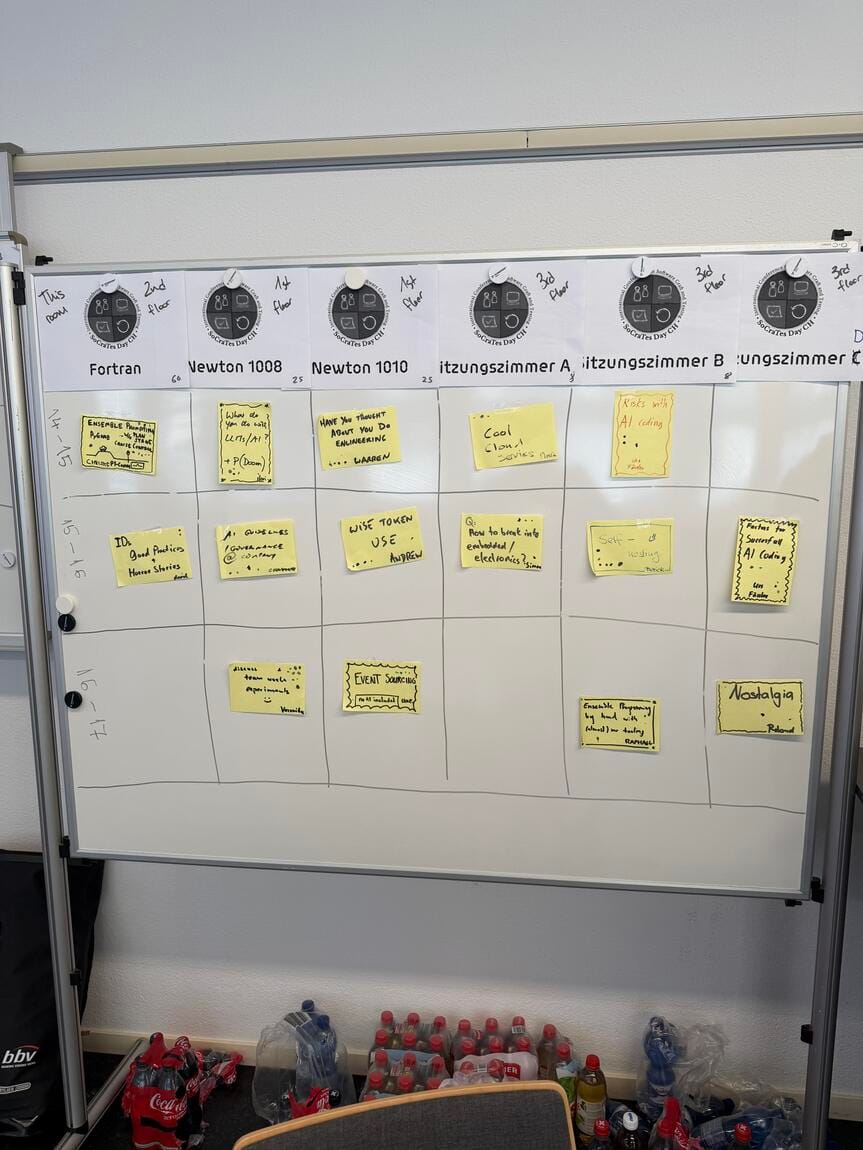
In between hung a few notes without AI on them. Self-hosting. Cool Cloud Services. How do I get into embedded and electronics. And down in the bottom right corner, in the last time slot, one note with a single word on it. Nostalgia. Right next to it, one about ensemble programming by hand, with almost no tooling.
I am not making a point of it, that is simply how it looked.
Cool Cloud Services
For me the cloud session was the most interesting one of the day. That is the part I work with professionally every day. Somebody else ran it, I listened and joined in.
What it left behind was a flip chart, sorted into AWS, GCP, Azure and Others. The interesting part is not the names but the annotations that keep coming back. Cheap. And CH. And what it actually does. Is it something special and exclusive or not? That was a very interesting part.
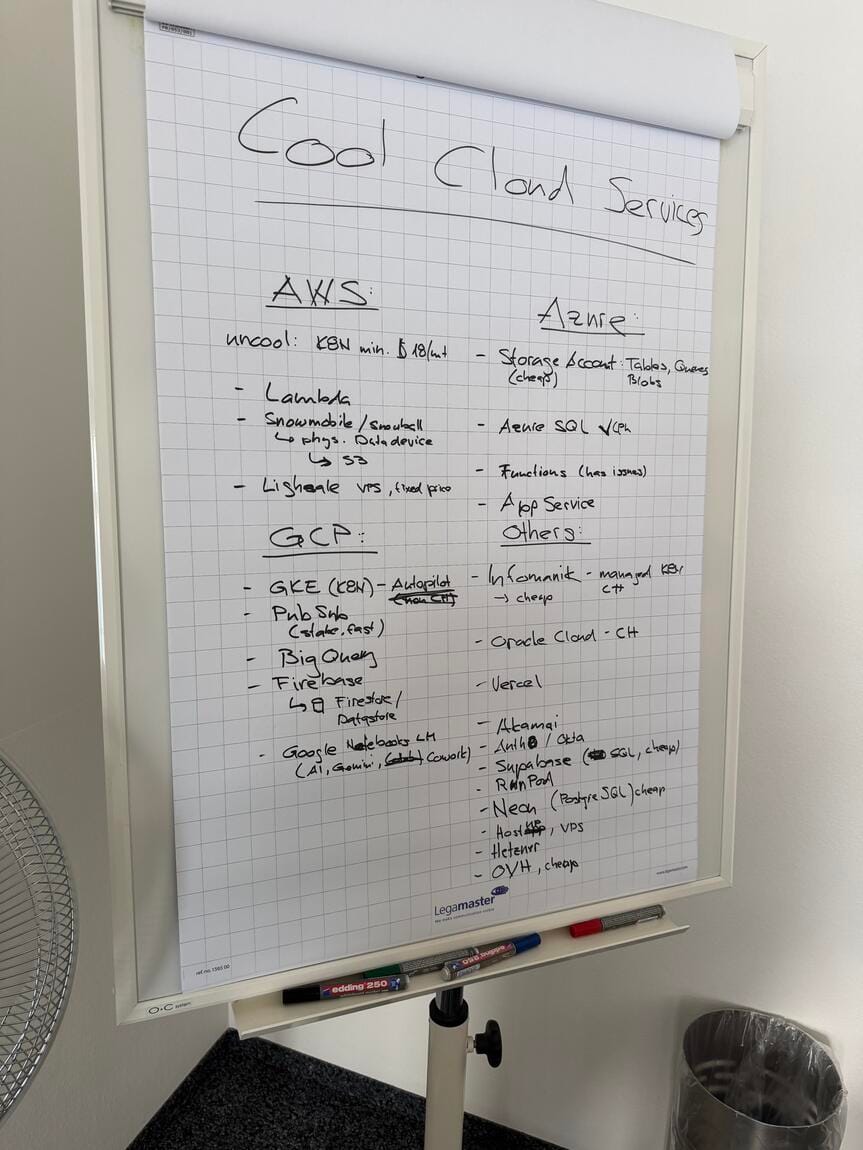
Under AWS, Kubernetes sat below the word uncool, with a monthly minimum fee next to it. Then Lambda, then Snowmobile and Snowball as physical devices that move data into S3, and Lightsail as a fixed-price VPS. Under GCP came GKE in Autopilot mode, Pub/Sub marked stable and fast, BigQuery, Firebase and Firestore.
Under Azure the storage account with tables, queues and blobs as the cheap option, Azure SQL with a tick and a CH beside it, Functions with the honest note has issues, App Service.
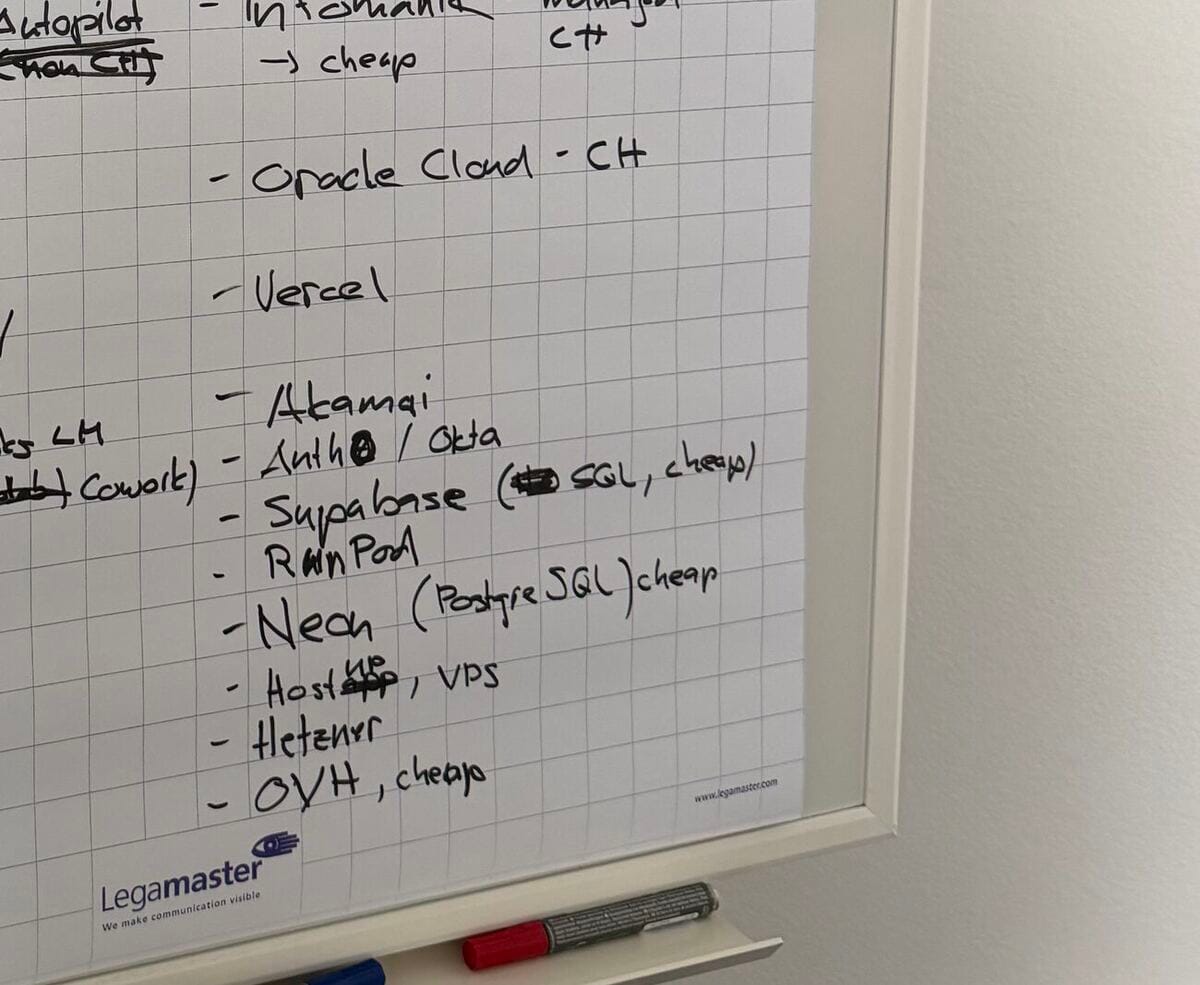
The longest column was Others. Infomaniak with cheap, managed Kubernetes and CH. Oracle Cloud with CH. Then Vercel, Akamai, Auth0 and Okta, Supabase and Neon as cheap Postgres options, RunPod, Hostinger, Hetzner and OVH.
A good part of the rest of the day went into hallway conversations, about AWS, Infomaniak and OpenStack, with whoever felt like it.
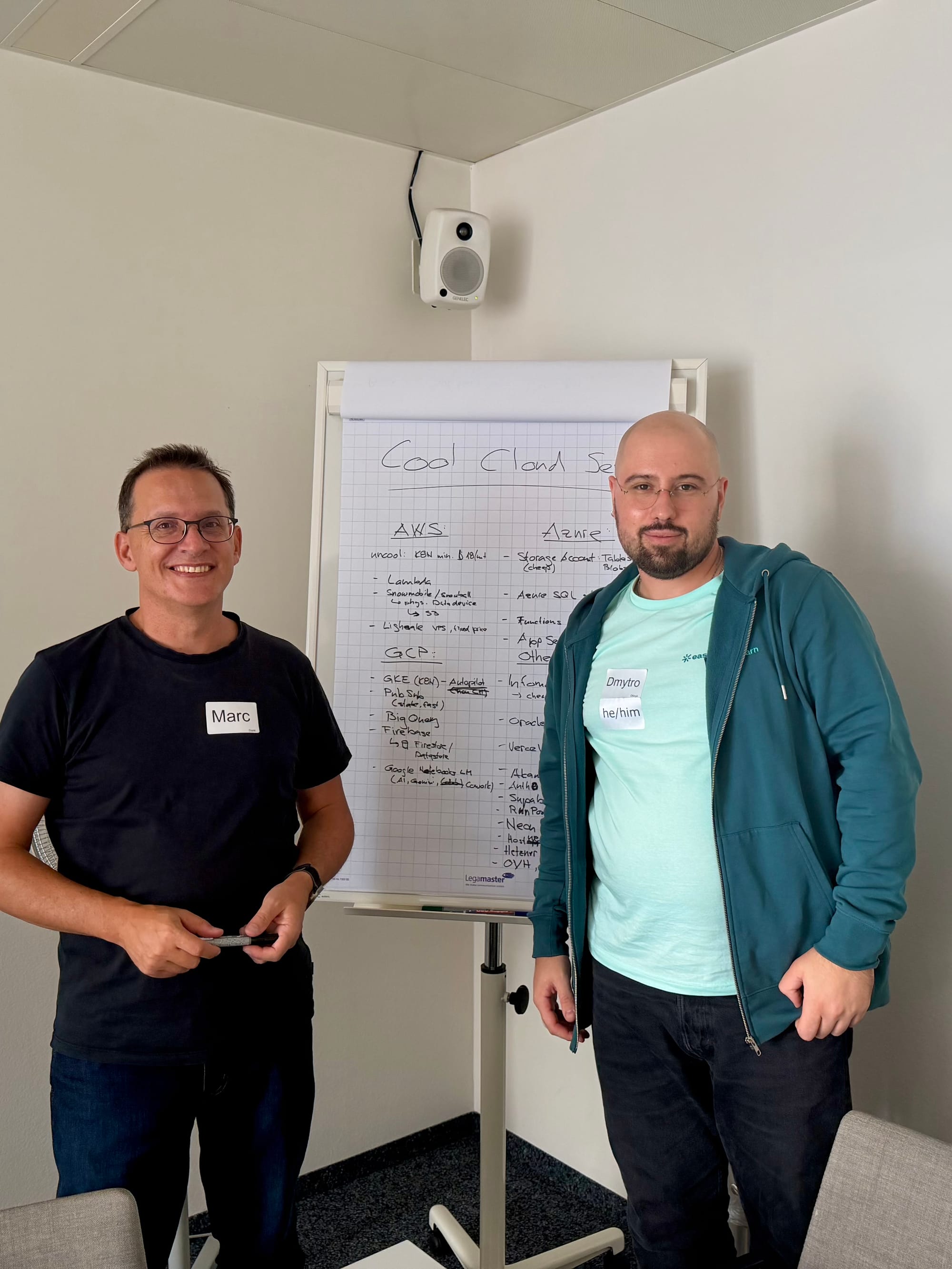
What stuck with me most was a conversation with Marc Dürst from Galaxus. I lost count of how many sessions I skipped for it, and it was worth every one.
The session about software that does not exist anymore
And then the note with the single word on it. No technical goal, no slides, just a group of people talking about software that does not exist anymore.
DC++. ICQ. Skype in its old form. All the peer-to-peer programs half of my generation grew up on. Everyone told the story of what they started with and how different development looked back then.
I mentioned that building an HTML table by hand used to be an achievement for me. Today almost nobody builds one by hand, the AI writes it in two seconds.
We mostly agreed that we miss the time when everything was simpler and did not move this fast. At the same time, a good part of the conversation was about how our old problems now just get solved with AI. Somebody pointed out that the big LLM providers forbid reverse engineering their own models and services in their terms of use. I did not know that before.
No idea whether that session produced anything. It was the warmest session of the day.
Scaffolding or offloading
Another session went straight at the question the nostalgia round had only circled. What does this tool do to us when we learn with it.
On the slides was a paper by Liu et al., "Tool, tutor, or crutch?", published in March 2026 in the International Journal of STEM Education. It draws two loops.
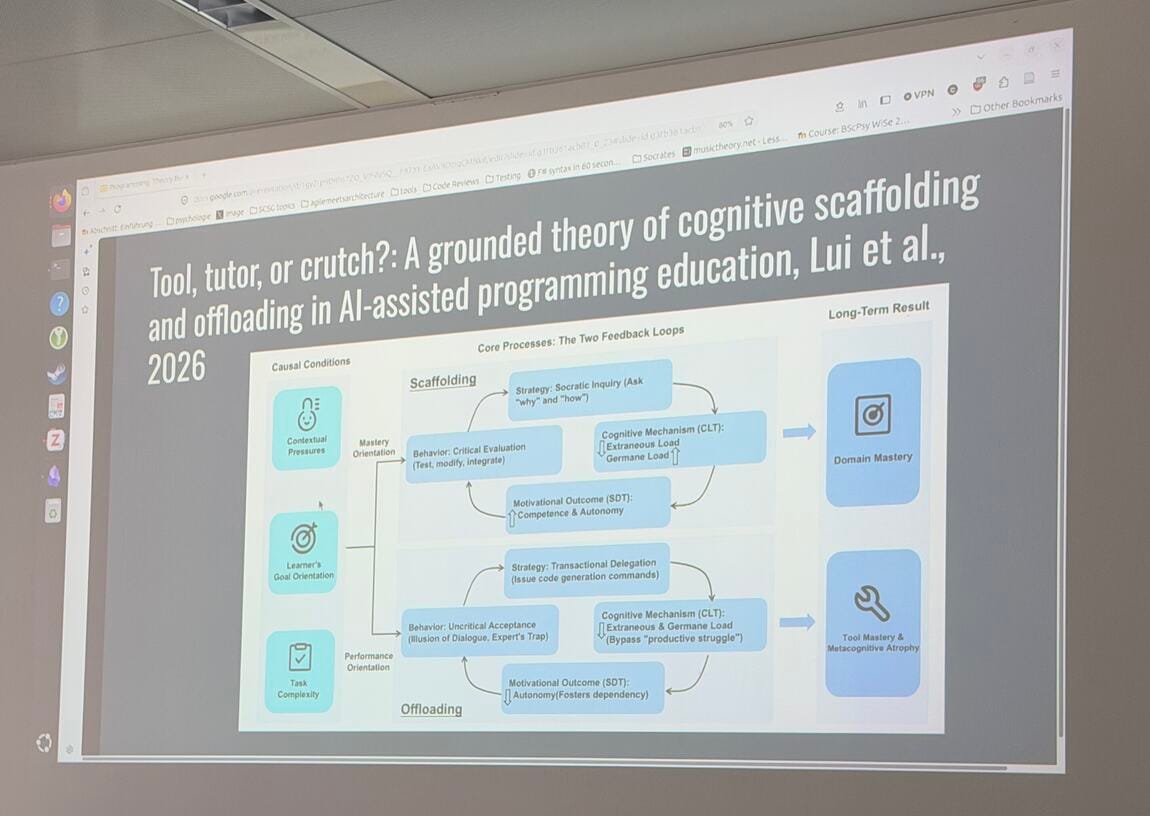
In the first one you ask the AI why and how, check what comes back, rebuild it, integrate it. That one ends at domain mastery.
In the second you only delegate. Have the code generated, accept it uncritically, move on. The paper calls that the illusion of dialogue. On the slide this loop ends at tool mastery and metacognitive atrophy. In between, you skip the productive struggle.
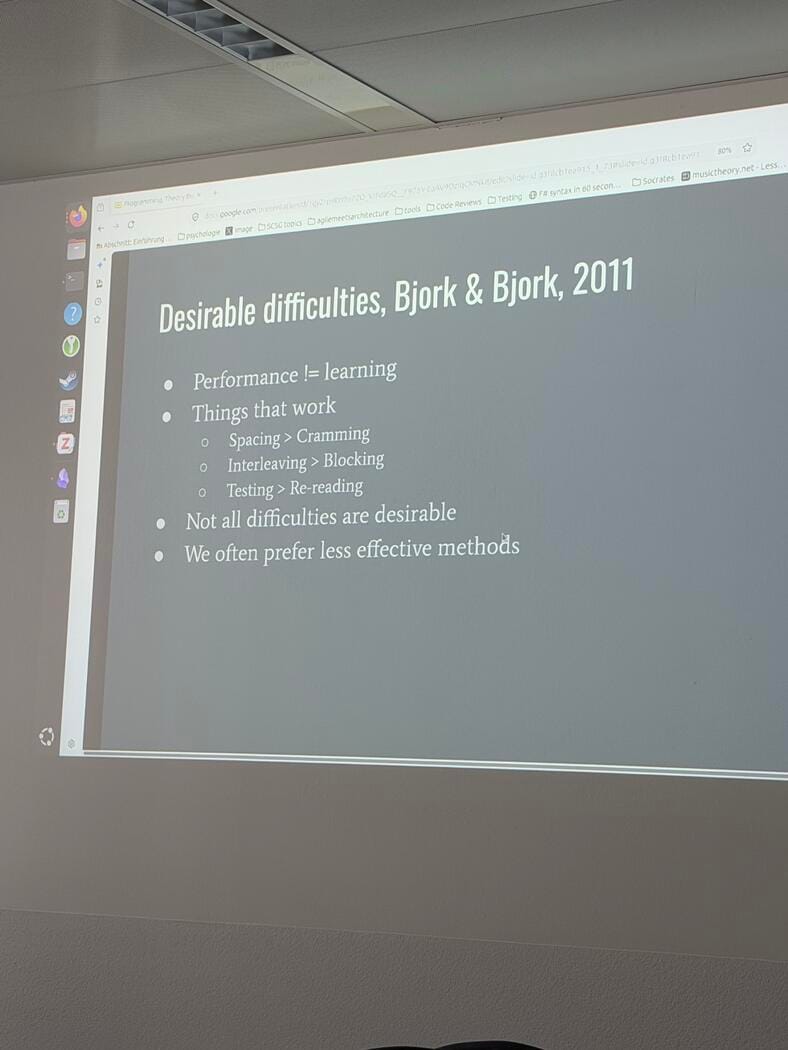
There was also a slide with Bjork and Bjork's desirable difficulties from 2011. Spacing beats cramming, interleaving beats blocking, testing yourself beats reading it again. Performance is not the same thing as learning, and we often prefer the method that feels better in the moment and does less.
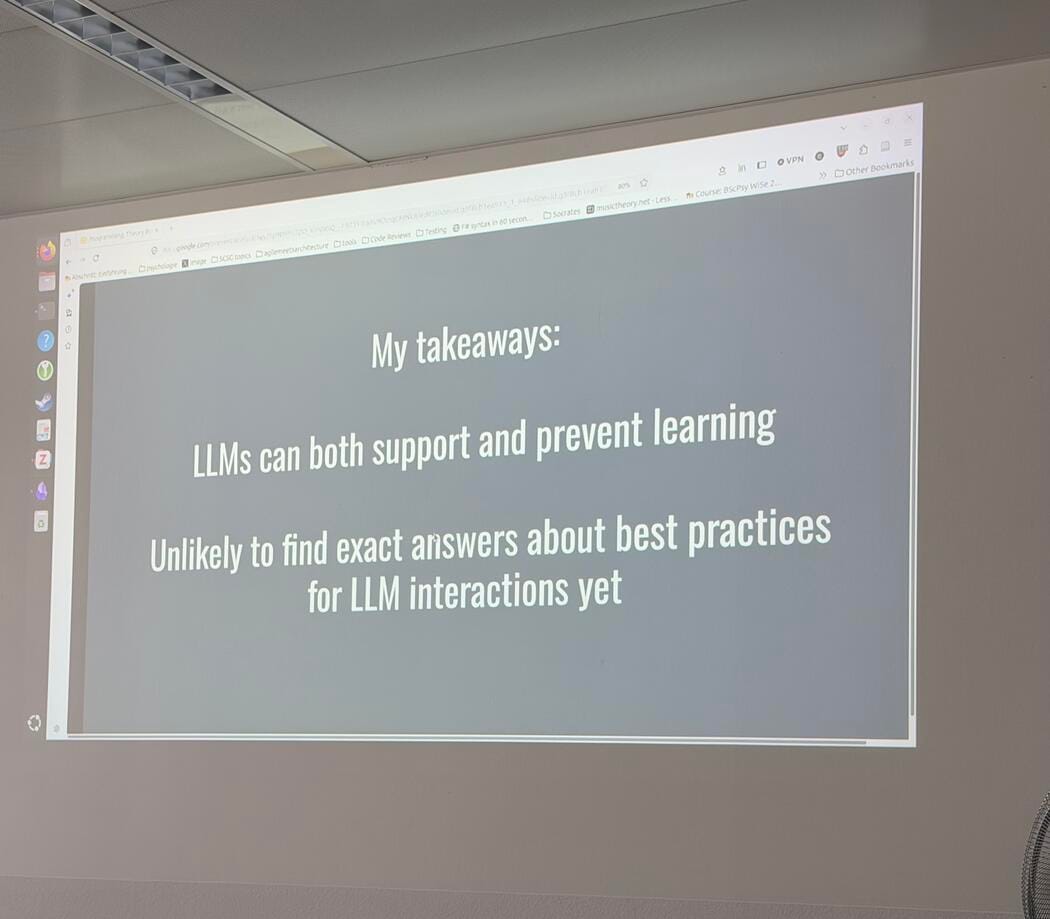
The summary in the talk was honest. LLMs can both support and prevent learning, and on the question of how to handle them properly there are no exact answers yet.
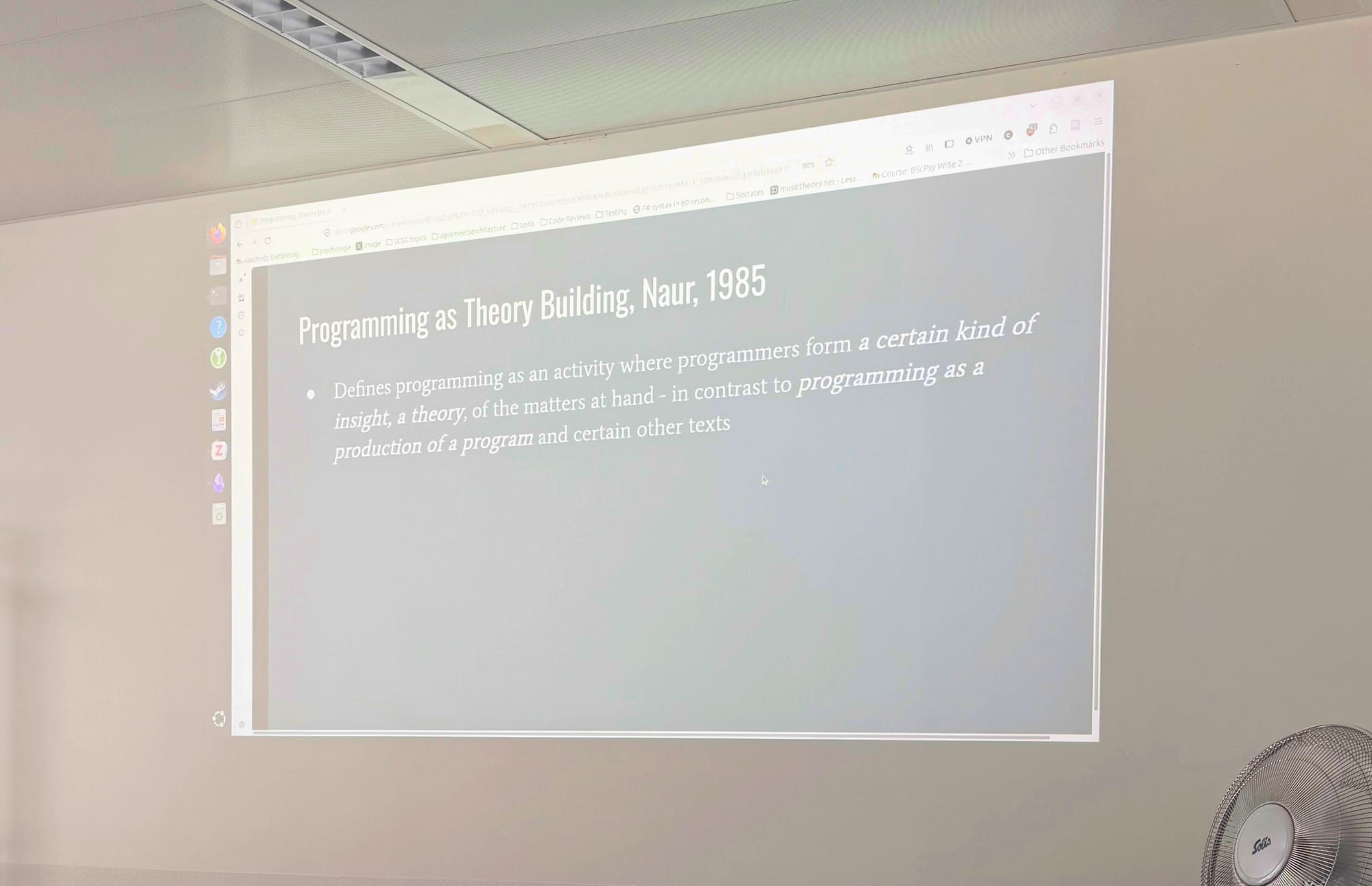
In another session Peter Naur's essay "Programming as Theory Building" from 1985 was up on the screen. Programming in it is theory building in the developer's head, and the program is only the by-product of that.
Lunch
Lunch was on the organisers, a green coupon for the canteen at Technopark. Rice, gyoza, curry, a can of my favorite El Tony's on the side.

The t-shirt
I showed up in an easylearn t-shirt, with a name badge that just said "Dmytro". Someone asked what easylearn actually does before I had introduced myself.
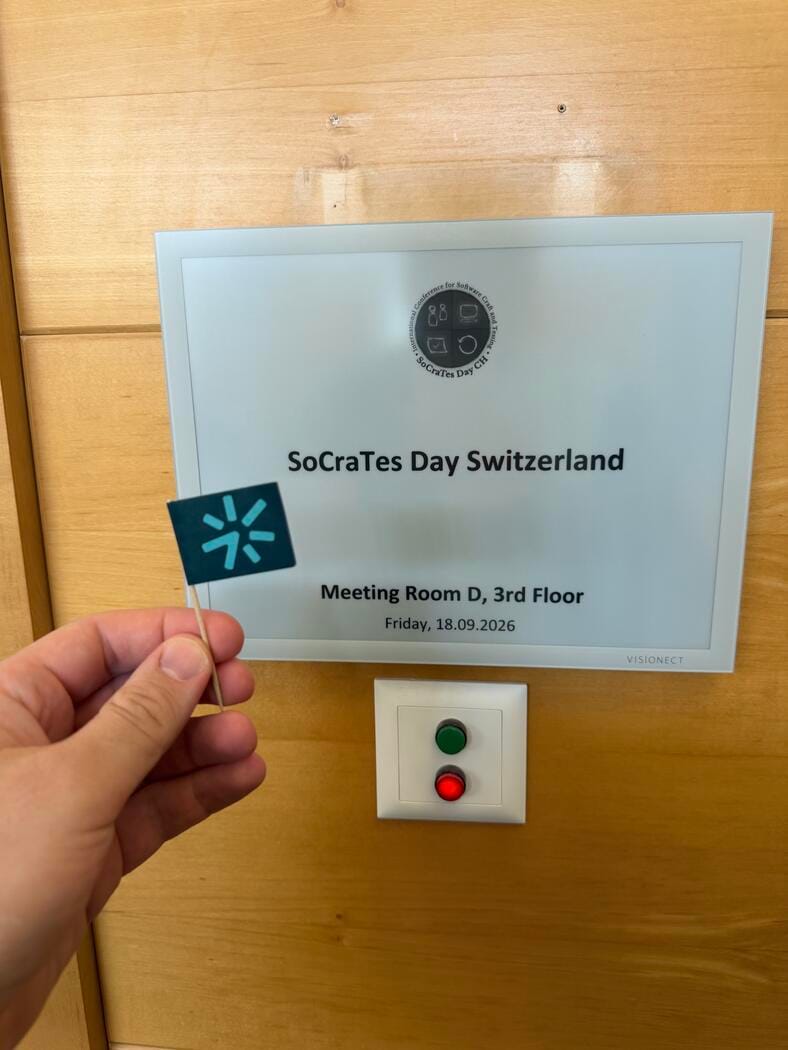
On top of that came a small paper flag with the easylearn logo, which I planted around the building for photos. Where the joke stops and actual marketing starts, I could not tell you anymore.
If you were there too and remember the day differently, write to me.
Discuss
Get new posts by email